
Berberine has become one of the most searched supplements in women's health — partly because of the comparisons to Ozempic, partly because the research is genuinely compelling. But how does berberine work, exactly? What is actually happening inside the body when berberine is absorbed?
This article breaks down the full mechanism — from AMPK activation to fat metabolism to why the method of delivery determines whether the science translates into real results.
What Is Berberine?
Berberine is a naturally occurring plant alkaloid found in several plants including barberry, goldenseal, and Oregon grape. It has been used in traditional Chinese and Ayurvedic medicine for centuries — originally for its antimicrobial and anti-inflammatory properties.
Modern research has revealed a far more significant metabolic role. Berberine is now one of the most studied natural compounds for blood sugar regulation, with a growing body of clinical evidence supporting its effect on insulin sensitivity, lipid metabolism, and body composition.
The AMPK Mechanism — How Berberine Actually Works
The core mechanism behind berberine's metabolic effects is AMPK activation. AMPK — adenosine monophosphate-activated protein kinase — is an enzyme present in virtually every cell in the body. It functions as a metabolic sensor and regulator, responding to cellular energy status.
When AMPK is activated, it essentially signals to the body that energy is needed — triggering a suite of responses that improve how the body processes glucose and manages fat storage.
Berberine enters the bloodstream
Via transdermal absorption (patch) or digestion (capsule). Transdermal delivery bypasses the digestive system and first-pass liver metabolism, providing more consistent blood levels.
AMPK is activated in target tissues
Berberine activates AMPK primarily in the liver, skeletal muscle, and fat tissue — the three sites most critical to glucose and fat metabolism.
Glucose uptake improves in muscle cells
AMPK activation increases glucose transporter expression (GLUT4) in muscle cells, allowing them to absorb glucose from the bloodstream more efficiently — reducing blood sugar levels without requiring insulin.
Liver glucose production is suppressed
AMPK inhibits gluconeogenesis — the liver's process of producing new glucose. This reduces fasting blood sugar levels significantly over time.
Fat oxidation increases, fat storage decreases
AMPK promotes fatty acid oxidation (fat burning) while simultaneously inhibiting fatty acid synthesis (fat storage) — shifting the body's energy balance toward using stored fat.
Berberine and Blood Sugar Regulation
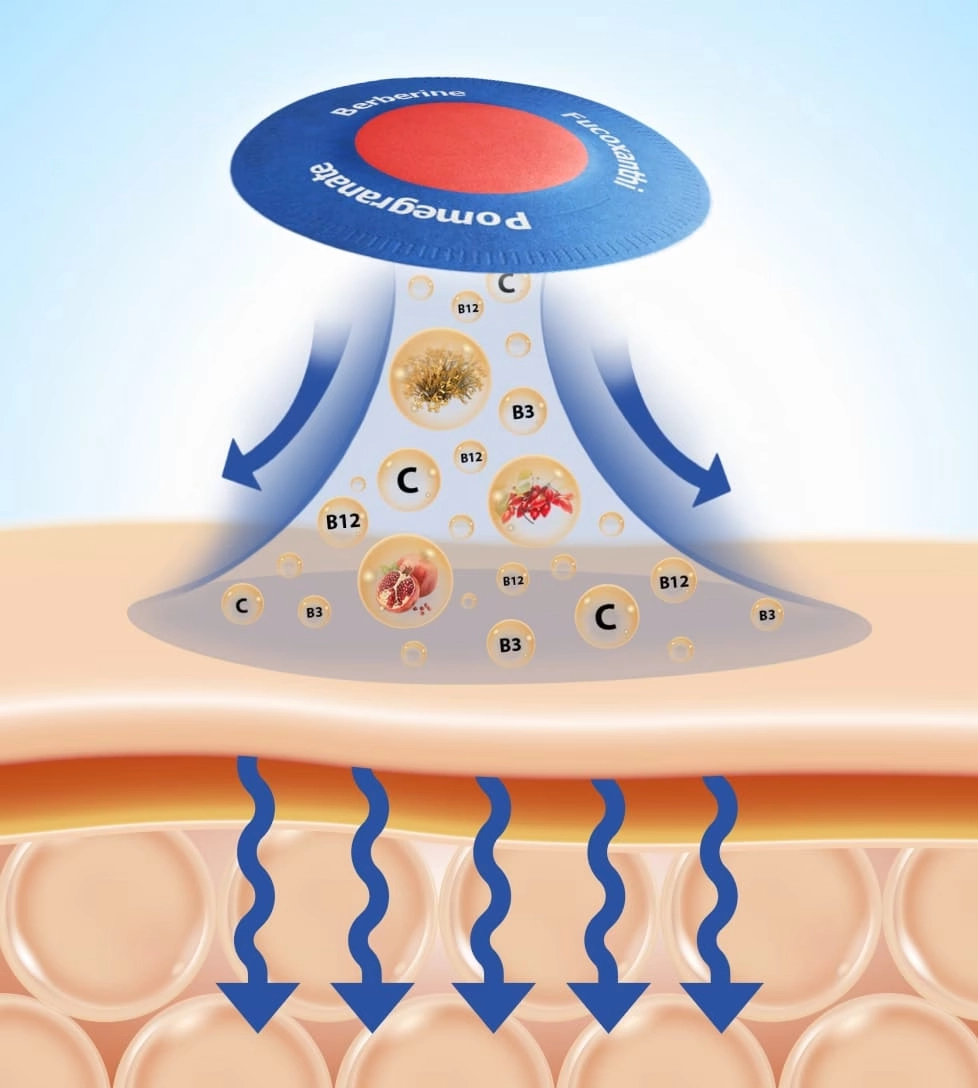
8 hours of steady berberine absorption — no pills, no scheduling, no crashes
Blood sugar dysregulation is the central driver of weight gain, energy crashes, cravings, and metabolic dysfunction in most women over 40. Berberine addresses this through multiple simultaneous pathways.
Reducing Post-Meal Glucose Spikes
Berberine inhibits alpha-glucosidase — an intestinal enzyme that breaks down carbohydrates into glucose. By slowing this process, berberine blunts the glucose peak after meals, which reduces the insulin response, which reduces the subsequent blood sugar crash that drives cravings 90–120 minutes after eating.
Improving Insulin Sensitivity
Over weeks of consistent use, berberine improves the sensitivity of insulin receptors — meaning cells respond more efficiently to the insulin signal. This reduces the body's need to produce excessive insulin, which in turn reduces fat storage signalling.
💡 The practical result: Women who use berberine consistently for 6–8 weeks typically report that the familiar afternoon energy crash and evening cravings significantly reduce in intensity. This is blood sugar stabilisation in action — not appetite suppression.
How Berberine Drives Fat Loss — Especially Around the Abdomen
Berberine's fat loss effect is not direct appetite suppression. It works by correcting the metabolic dysfunction that causes fat to accumulate in the first place — particularly visceral fat around the abdomen.
Visceral fat is not simply stored energy. It is metabolically active tissue that produces inflammatory signals and further worsens insulin resistance — creating a cycle where fat accumulation drives more fat accumulation. Berberine interrupts this cycle at the insulin sensitivity level.
Clinical trials have demonstrated modest but consistent reductions in BMI and waist circumference in overweight participants using berberine over 8–12 weeks. The effect is most pronounced in participants with insulin resistance — which describes the majority of women over 40.
Berberine vs Ozempic — What Women Are Actually Comparing
The "natural Ozempic" comparison has driven enormous interest in berberine. It is worth understanding what is accurate and what is not.
What they share: Both berberine and GLP-1 medications like Ozempic improve blood sugar regulation and reduce appetite-driving blood sugar instability. Both produce weight loss, particularly visceral fat reduction, with consistent use.
Where they differ: Ozempic works through direct GLP-1 receptor agonism — producing stronger, faster appetite suppression. It also carries a significant side effect profile, requires injection, and costs substantially more. Berberine produces more modest effects through AMPK activation — without side effects, without a prescription, and without injection.
⚠️ Important: Berberine is not a pharmaceutical equivalent to Ozempic and should not be treated as one. It is a natural metabolic support compound with a different mechanism, different effect size, and a far lower risk profile.
Why Delivery Method Changes the Outcome
Understanding how berberine works makes the delivery question obvious: if the goal is consistent AMPK activation over weeks, you need consistent berberine levels in the bloodstream over weeks.
Oral capsules produce blood level spikes after each dose and troughs between doses. They also cause GI side effects that force most users to stop before any metabolic benefit develops.
The Purisaki Berberine Patch delivers berberine transdermally over 8 hours — providing steady, consistent blood levels throughout the day from a single daily application. No GI side effects. No dosing schedule. No reasons to stop.
See the full review: 8-week personal trial results, ingredient breakdown, and verified buyer feedback on the Purisaki Berberine Patch.
The Bottom Line
The Science Is Solid — Completion Is the Variable
Berberine's mechanism is well-understood and well-researched. AMPK activation, improved insulin sensitivity, reduced blood sugar spikes, increased fat oxidation — the biology is real. The difference between women who see results and those who do not is almost entirely down to whether they complete the protocol long enough for those mechanisms to produce visible change.